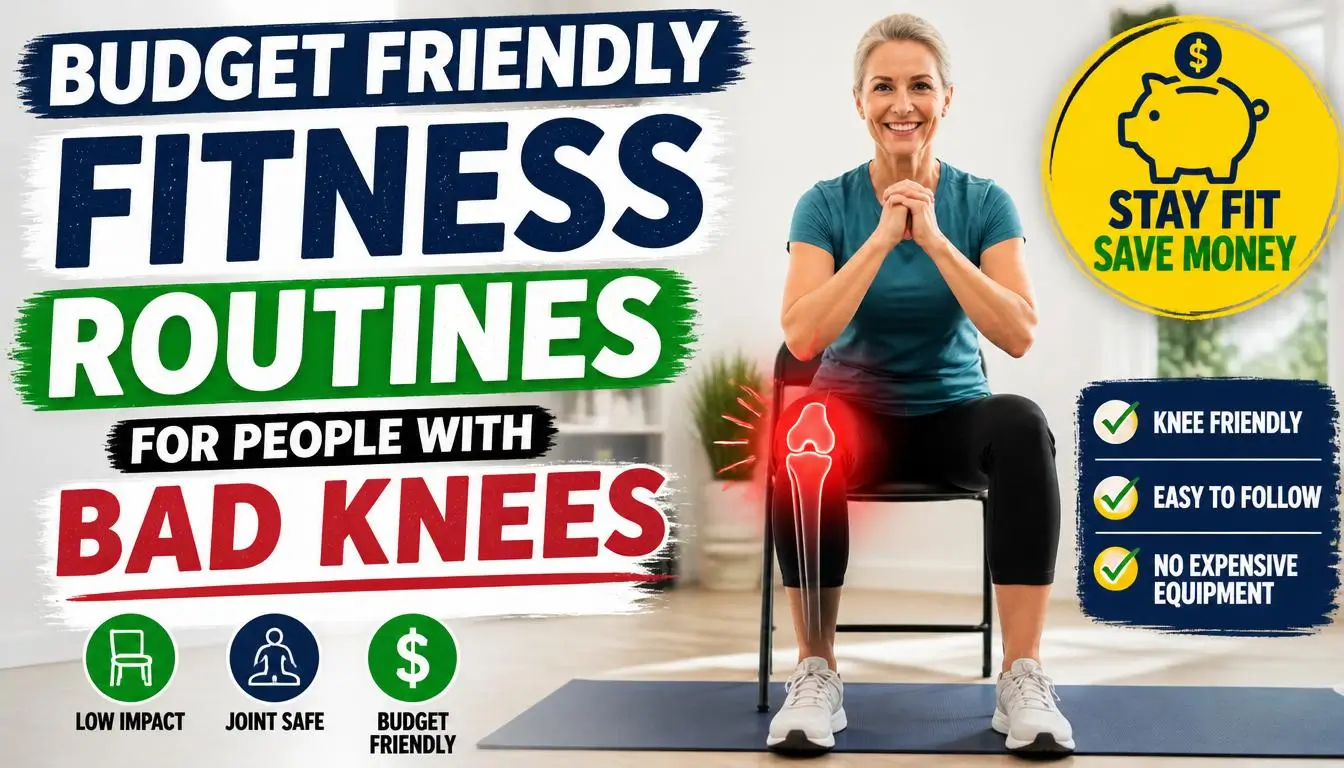
Finding budget friendly fitness routines for people with bad knees felt impossible when my orthopedist first told me I had early cartilage wear at 34. Every program I looked at involved jumping, lunging, or equipment that cost hundreds of dollars. I thought staying fit on a tight budget with cranky knees was a contradiction. Turns out, it absolutely is not. I just needed to stop copying what worked for everyone else and build something that worked for my body.
Why Bad Knees Don’t Mean No Exercise
A lot of people hear “bad knees” and picture themselves stuck on a couch forever. I get it. After my diagnosis, I avoided anything physical for almost six months because I was terrified of making things worse. But my physical therapist said something that stuck with me: inactivity actually accelerates knee deterioration. Your joints need movement. They need the muscles around them to stay strong.
The trick is choosing low-impact movements that strengthen without grinding. You don’t need a gym membership. You don’t need a Peloton. You need smart movement, consistency, and patience. That combination costs almost nothing, and it genuinely works.
1. Walking With Intention
I know, walking sounds boring. But hear me out. Walking on flat, even surfaces is one of the best things you can do for bad knees, and it costs zero dollars. The key is walking with intention, not just shuffling to the mailbox and back.
I started with 15-minute walks on a local track and built up to 40-minute sessions over two months. I focused on keeping a steady pace, landing heel-to-toe, and wearing shoes with decent arch support. Asics Gel-Contend shoes run around $50 and made a real difference compared to the flat Converse I was wearing before. Walk daily, even if it’s short. Your knees will thank you.
2. Chair-Based Strength Training
This one surprised me the most. You can get a legitimately tough workout using nothing but a sturdy kitchen chair. Seated leg extensions, seated marches, and sit-to-stand squats all build the quads and glutes that stabilize your knees, and none of them require you to drop into a deep squat or lunge.
I do three rounds of 12 reps for each movement, three days a week. The whole thing takes about 20 minutes. If you want to add resistance, a set of light ankle weights from Amazon costs around $15. I bought the BalanceFrom brand and they’ve lasted over a year. No gym needed, no fancy setup, just you and a chair.
3. Resistance Band Workouts
Resistance bands are the single best investment I’ve made for knee-friendly fitness. A full set from Fit Simplify or SPRI costs between $10 and $20, and they replace hundreds of dollars worth of weight machines.
I use them for lateral band walks, monster walks, clamshells, and standing hip abductions. All of these target the hip and glute muscles that, when weak, put extra stress on your knees. My physical therapist originally prescribed these exercises, and I’ve kept doing them long after my sessions ended. They’re portable, they’re quiet, and they work whether you’re in your living room or a hotel room. If you buy one piece of equipment from this entire list, make it a set of resistance bands.
4. Swimming and Water Walking
Pool access is cheaper than most people think. My local YMCA offers a basic membership for $35 a month, and many community recreation centers charge even less. Some towns have free open-swim hours during the summer.
Water takes roughly 90% of your body weight off your joints. Swimming laps or even just walking back and forth in the shallow end builds cardiovascular fitness and leg strength without the pounding. I started going twice a week and noticed my knees felt noticeably looser and less stiff within the first month. If a pool membership stretches your budget, look for community programs, senior swim passes (they’re often open to anyone with joint issues), or local deals on Groupon.
5. YouTube Yoga and Stretching Routines
Free yoga videos saved my flexibility. Channels like “Yoga With Adriene” and “SeniorShape Fitness” on YouTube have specific routines designed for people with knee pain. I follow along in my living room three mornings a week, and the total cost is whatever I’m already paying for internet.
The key is avoiding deep knee bends and full kneeling positions. I keep a folded towel under my knees whenever a pose requires any floor contact, and I skip anything that feels sharp rather than stretchy. Gentle yoga improves your range of motion, reduces stiffness, and helps you sleep better. That last part was an unexpected bonus I didn’t appreciate until I experienced it.
6. Stationary Cycling on a Budget
A brand-new spin bike costs a fortune, but a basic stationary bike does not. I found a used Sunny Health & Fitness magnetic bike on Facebook Marketplace for $60. These bikes retail around $200 new, and used ones pop up constantly because people buy them and never use them.
Cycling keeps your knees moving through a smooth, controlled range of motion without impact. I ride for 20 to 30 minutes on low to moderate resistance while watching TV. It doesn’t feel like a punishment, which is honestly why I’ve stuck with it. If even a used bike is out of budget, seated pedal exercisers cost around $25 and fit under a desk or in front of a couch. They’re not as smooth, but they get the job done.
7. Bodyweight Floor Exercises
Glute bridges, straight-leg raises, and dead bugs are three exercises that build serious core and lower body strength without putting any pressure on your knees. I do these on a basic yoga mat I bought at Walmart for $8.
Glute bridges target your hamstrings and glutes. Straight-leg raises hit your quads without bending your knee at all. Dead bugs strengthen your core, which improves your overall stability and takes stress off your lower body joints. I cycle through these three exercises in a circuit, 3 sets of 15 reps each, and the whole thing takes less than 15 minutes. No equipment, no cost, no excuses. These moves look simple, but after three sets you will feel them.
8. Upper Body Focused Workouts
Bad knees don’t affect your arms, shoulders, chest, or back. I spent months ignoring my upper body because I mentally categorized all exercise as “stuff my knees won’t let me do.” That was a mistake.
A pair of adjustable dumbbells from CAP Barbell costs around $30 at Walmart. With those and a chair, you can do seated overhead presses, bicep curls, lateral raises, and seated rows using a resistance band anchored to a doorknob. Training your upper body keeps your metabolism active, improves posture, and honestly just makes you feel stronger and more capable. I train upper body twice a week and it has become my favorite part of my routine.
Building a Weekly Schedule That Actually Works
Throwing random exercises together without a plan leads to inconsistency. Trust me, I tried that approach for months. Here’s the simple weekly schedule I follow now that keeps me consistent and keeps my knees happy:
- Monday: Resistance band lower body workout (20 minutes)
- Tuesday: Walking (30 to 40 minutes)
- Wednesday: Upper body dumbbells and seated exercises (25 minutes)
- Thursday: Pool session or stationary bike (30 minutes)
- Friday: Yoga or stretching video on YouTube (20 minutes)
- Saturday: Walking plus bodyweight floor exercises (35 minutes)
- Sunday: Rest
This schedule is flexible. If my knees feel extra cranky on a Tuesday, I swap in an upper body day instead. The point is having a plan so you’re not standing in your living room at 6 PM wondering what to do and then doing nothing.
Budget Friendly Fitness Routines for People With Bad Knees: What to Avoid
Knowing what not to do matters just as much as knowing what to do. I learned some of these lessons the hard way, so maybe you won’t have to.
High-Impact Exercises
Running, jumping jacks, box jumps, and burpees are all off the table. I tried a HIIT video about three months after my diagnosis and my left knee was swollen for a week. Impact forces can be two to three times your body weight, and compromised cartilage can’t absorb that.
Deep Squats and Lunges
Partial squats are fine for many people with knee issues, but going below parallel puts enormous shear force on the joint. Walking lunges are similarly risky. I replaced both with wall sits and chair squats, which limit range of motion to a safer zone.
Ignoring Pain Signals
There’s a difference between muscle soreness and joint pain. Muscle soreness feels like a dull ache in the belly of the muscle and fades within 48 hours. Joint pain is sharp, localized, and sometimes comes with swelling. If you feel the second type, stop. Pushing through joint pain is not tough, it’s just damaging.
FAQs
Can I really get fit with bad knees and no gym membership?
Absolutely. I’ve maintained my fitness for over two years using home workouts, outdoor walks, and the occasional pool session. Resistance bands, a yoga mat, and free YouTube videos cover almost everything you need. A gym is nice, but it is not required to stay active and strong with knee problems.
What’s the cheapest equipment for knee-friendly workouts?
A set of resistance bands is the best bang for your buck at around $10 to $20. After that, a yoga mat for $8 to $15 and a pair of light ankle weights for about $15 round out a solid home setup. You can build a full routine around budget friendly fitness routines for people with bad knees with under $50 total.
How often should I work out if I have knee pain?
I aim for five days a week, alternating between lower body, upper body, and flexibility work. Rest days matter because they give your joints time to recover. If your knees are especially irritated, take an extra rest day or switch to a non-weight-bearing activity like swimming or upper body training.
Should I wear a knee brace during workouts?
A basic compression sleeve from Cambivo or PowerLix costs about $15 and can help with stability and mild swelling. I wear one during walks and cycling. It’s not a substitute for proper form or strengthening exercises, but it adds a layer of support that makes movement feel more confident. Ask your doctor if a hinged brace would be more appropriate for your specific condition.
Is cycling or swimming better for bad knees?
Both are excellent, and honestly, the best one is whichever you’ll actually do consistently. Swimming offers more full-body resistance and zero impact. Cycling is easier to do at home and doesn’t require pool access. I alternate between both throughout the week because variety keeps me from getting bored.
Conclusion
Living with bad knees forced me to get creative, and I ended up with a fitness routine I actually enjoy more than the one I had before. You don’t need expensive equipment or a fancy gym to stay strong and active. What’s the one exercise from this list you’re going to try first?