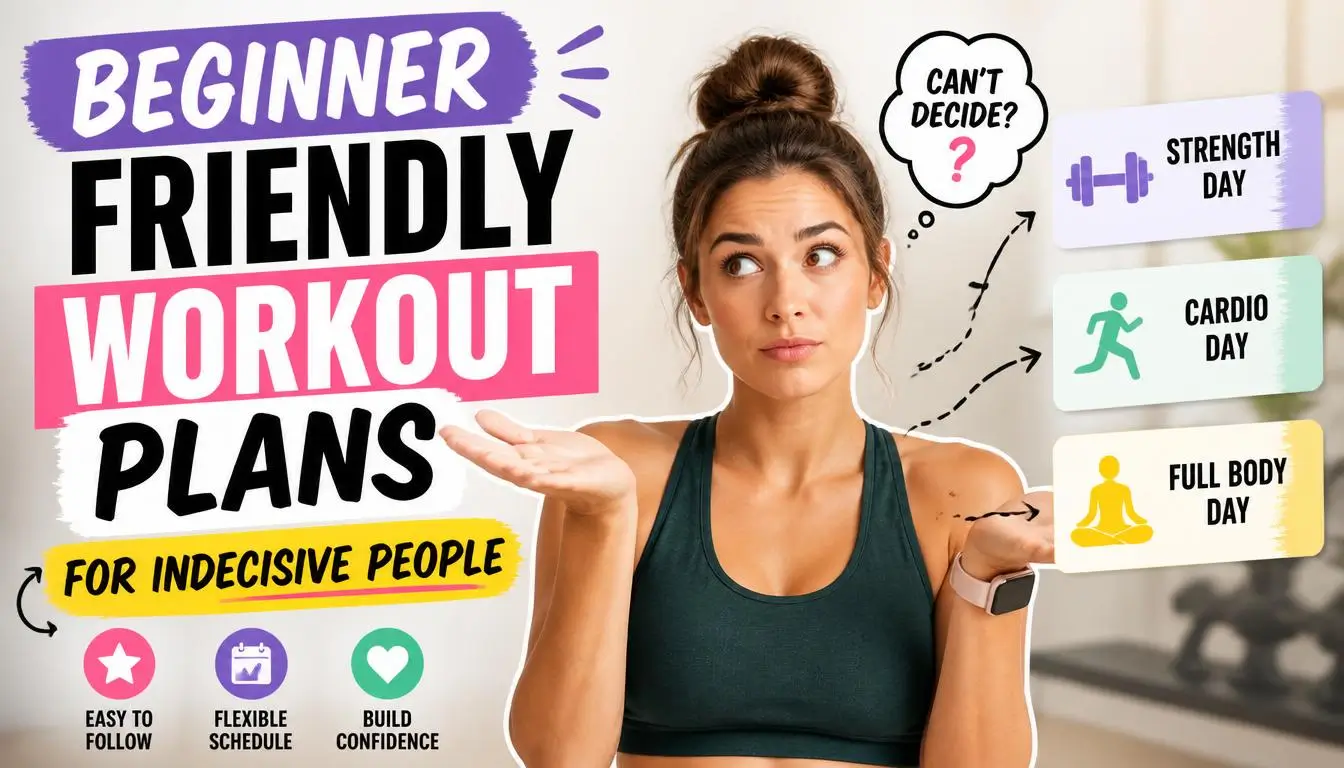
If you’ve ever searched for beginner friendly workout plans for indecisive people and ended up with 47 browser tabs open, zero decisions made, and a growing sense of guilt, I wrote this for you. I spent years bouncing between running, yoga, CrossFit, Pilates, and whatever TikTok was hyping that week. I never stuck with anything because I could never commit to one thing. Turns out, I didn’t have to.
1. The “Rotation Method” That Finally Worked for Me
I stumbled onto this approach after my third failed attempt at a 12-week running program. The rotation method means you pick three or four activities you genuinely enjoy and cycle through them on a weekly schedule. Monday might be a 20-minute YouTube yoga session. Wednesday could be a brisk walk or jog. Friday, maybe some bodyweight strength work.
The magic here is that you never get bored because your next workout is always something different. You still build consistency because the schedule stays the same, even if the activity changes. I personally rotate between Caroline Girvan’s strength videos on YouTube, a local Zumba class, and trail walks. Three months in, I haven’t quit once.
2. Try a “Sampler Week” Before Committing to Anything
Most gyms and fitness apps offer free trials, and you should absolutely abuse that. Spend one full week doing a different workout every single day. Monday yoga, Tuesday spin, Wednesday swimming, Thursday dance cardio, Friday weightlifting. Treat it like a buffet.
Write down how each one made you feel afterward, not during, because everything feels hard during. The ones that left you feeling energized rather than drained are your winners. I did this with the Peloton app’s free trial and realized I loved cycling but absolutely hated their strength classes. That one week of experimenting saved me months of forcing something that wasn’t going to stick.
3. The “Follow a Person, Not a Program” Strategy
Here’s something nobody told me when I started: you don’t need a structured 8-week plan. You need a trainer or creator whose vibe you actually enjoy. When you like the person guiding you, you show up even when the workout itself doesn’t excite you.
Sydney Cummings on YouTube posts a new free workout almost every day, and they vary wildly between strength, HIIT, and low impact. Heather Robertson does something similar with structured monthly calendars that mix everything together. For indecisive beginners, this approach removes all decision-making. You just press play on whatever today’s video is. I followed Sydney for two straight months before I even realized I’d built an actual habit.
Beginner Friendly Workout Plans for Indecisive People Who Hate Repetition
If doing the same routine twice makes your skin crawl, you’re not lazy or unfocused. Your brain just craves variety, and that’s a completely valid way to exercise. The fitness industry loves to push “pick one thing and master it,” but plenty of research supports cross-training as both effective and sustainable for general health.
A simple framework that works: alternate between three categories each week. One day of cardio (walking, cycling, dance, swimming), one day of strength (dumbbells, resistance bands, bodyweight), and one day of mobility (yoga, stretching, Pilates). That’s three workouts a week with built-in variety. You never repeat the same session two days in a row, and you hit all the major fitness bases without overthinking it.
I kept a sticky note on my bathroom mirror with just those three words: cardio, strength, mobility. Each week I’d pick whatever sounded least terrible for each category. Some weeks that meant a dance workout, kettlebell swings, and yin yoga. Other weeks it was jump rope, push-up variations, and a 15-minute stretch from the Nike Training Club app. Both weeks counted.
4. Use an App That Decides for You
Decision fatigue is real, and it absolutely applies to fitness. If choosing a workout feels like picking a restaurant with a group of friends, let technology handle it. Several apps are specifically designed to remove the guesswork.
FitOn is free, has tons of variety, and lets you filter by time, equipment, and mood. The Nike Training Club app builds adaptive plans based on your preferences and adjusts as you go. Apple Fitness+ rotates new workouts constantly across dozens of categories, so there’s always something fresh. I used FitOn for about six months before switching to Apple Fitness+, and both worked precisely because I never had to choose from scratch. The app narrowed my options down to two or three, and picking from a short list feels completely different than staring at an infinite menu.
5. The 15-Minute Rule for People Who Overthink Everything
When I couldn’t decide what to do, I’d often end up doing nothing. My therapist (yes, I brought my workout indecision to therapy) suggested the 15-minute rule: commit to just 15 minutes of literally any movement. Walking counts. Dancing in your kitchen counts. A single set of squats while your coffee brews counts.
The trick is that 15 minutes feels so low-stakes that your brain stops resisting. And here’s what actually happens about 80% of the time: once you start, you keep going. I can’t tell you how many 15-minute “I’ll just do some stretching” sessions turned into 40-minute full workouts. But even when they didn’t, 15 minutes of movement is still infinitely better than zero minutes spent scrolling through workout options.
6. Pair Workouts with Stuff You Already Do
This one sounds almost too simple, but it genuinely changed my consistency. Instead of treating exercise as a separate event that requires motivation, planning, and the right outfit, I attached it to things I was already doing.
Listening to a podcast? Walk while you listen. Watching a Netflix show? Only watch it while on a stationary bike or treadmill (I burned through all of “Beef” this way). Waiting for dinner to cook? That’s 20 minutes of bodyweight exercises in the kitchen. Morning coffee ritual? Five minutes of stretching before the first sip. When the workout piggybacks on an existing habit, there’s nothing to decide. The habit triggers the movement automatically.
7. Join a Class Where Someone Else Runs the Show
Group fitness classes solve the indecision problem completely because you literally just show up. Someone else planned the workout, someone else tells you what to do, and you follow along. For indecisive beginners, this removes every single barrier.
Most local gyms and YMCAs offer beginner-level classes in everything from kickboxing to water aerobics. ClassPass lets you try different studios without committing to one membership, which is perfect if variety matters to you. I rotated between three different studios for a while: a barre class on Mondays, a boxing gym on Wednesdays, and a community yoga studio on weekends. The variety kept me interested, and the scheduled class times kept me accountable. If someone else is expecting you to show up at 6 PM, you show up at 6 PM.
8. Build a “Menu” You Can Pull From Anytime
Think of this like meal prepping, but for workouts. Spend 30 minutes one Sunday writing down 10 to 15 workouts you’d actually enjoy. Include the specific video link, the equipment needed, and the estimated time. Organize them loosely by category (cardio, strength, flexibility) and stick the list on your fridge or keep it in your phone’s notes app.
Now when it’s time to exercise, you’re not browsing YouTube or scrolling through an app. You’re picking from a curated list you already vetted. I keep mine in a Google Doc and update it every month or so when I find new videos I like. The key is keeping the list short enough to prevent decision paralysis but long enough that nothing feels repetitive. Ten to fifteen options hits that sweet spot perfectly.
Why Traditional Workout Plans Fail Indecisive Beginners
Most beginner programs assume you’ve already decided what you want to do, and they ask you to repeat it for weeks. That structure works great for some people. For indecisive types, it’s a recipe for quitting by week three.
The problem isn’t motivation. It’s rigidity. When a plan says “Day 14: Leg Day, same exercises as Day 7,” your brain screams for something new. You skip the workout, feel guilty, skip the next one, and eventually abandon the whole thing. I did this with Couch to 5K twice, Strong Curves once, and at least three different “30-day ab challenges.” The plans weren’t bad. They just weren’t built for the way my brain works.
The beginner friendly workout plans for indecisive people that actually stick are the ones with built-in flexibility. They give you structure without suffocating you. A framework, not a script.
Frequently Asked Questions
Is it okay to do a different workout every day as a beginner?
Absolutely. As long as you’re not going extremely intense every single day, variety is actually great for beginners. It works different muscle groups, prevents overuse injuries, and keeps you from burning out mentally. Just make sure you include at least one or two rest days per week, and listen to your body when something feels off.
What’s the best free app for beginner friendly workout plans for indecisive people?
FitOn is probably the strongest free option right now. It has hundreds of workouts across every category, solid filters, and no paywall for most content. YouTube is also incredible if you follow creators like Sydney Cummings or Heather Robertson, who post varied daily workouts you can follow without planning anything yourself.
How many days a week should an indecisive beginner actually work out?
Three days is a great starting point. It’s enough to build a habit and see progress without feeling overwhelming. If three feels easy after a few weeks, bump it to four. The specific number matters way less than showing up consistently, even if “showing up” means a 15-minute kitchen dance session.
Will switching workouts constantly slow down my progress?
For general fitness, health, and feeling good, not really. You might progress slower in one specific skill compared to someone who only does that skill. But for beginners, the biggest priority is building a sustainable habit. Consistency across varied workouts beats perfection in a program you quit after two weeks.
How do I know when I’m ready to commit to one type of workout?
You’ll feel it naturally. After a few months of rotating, most people start gravitating toward one or two activities they genuinely look forward to. That pull is your sign. But honestly, some people thrive on variety forever, and that’s completely fine too. There’s no rule that says you have to specialize.
Conclusion
The best workout plan isn’t the one with the most science behind it or the fanciest programming. It’s the one you actually do, repeatedly, without dreading it. If that means doing something different every single session for the rest of your life, that’s a perfectly solid strategy. So what’s going on your rotation this week?